🌿 proGIreg Project Summary: Nature-Based Urban Regeneration
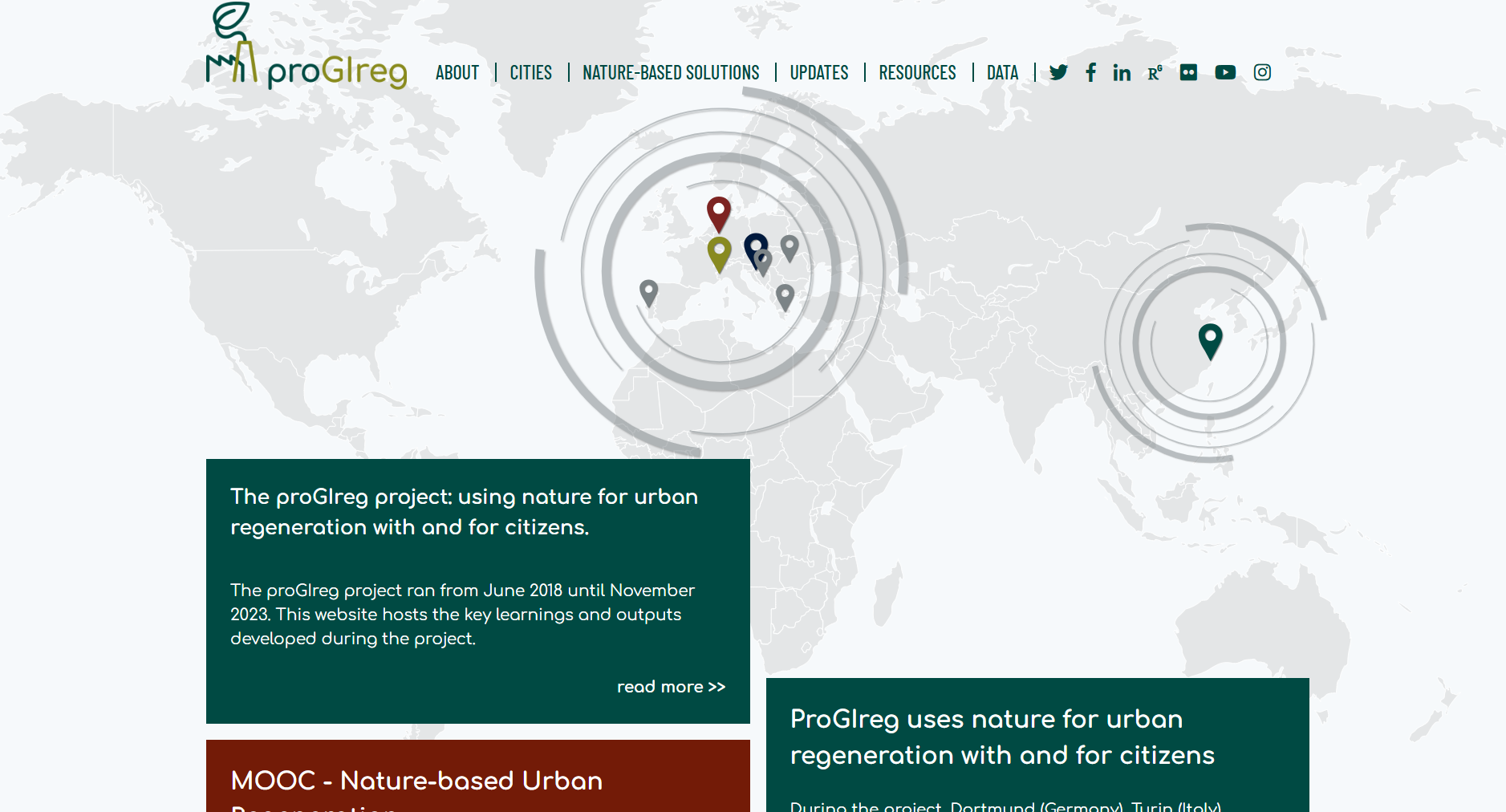
The proGIreg project (productive Green Infrastructure for post-industrial urban regeneration) focused on using Nature-Based Solutions (NBS) to transform post-industrial urban areas plagued by social, economic, and environmental disadvantages.
🎯 Project Context and Objectives
The primary goal was to create Living Labs (LLs) in cities lacking quality green spaces to improve human health, well-being, and climate resilience. Innovations occurred on three levels:
- Technical: Deployment of specific NBS (e.g., aquaponics, soil regeneration).
- Social: Co-design and co-implementation involving state, market, and civil society.
- Economic: Development of new business models (BMs) for NBS.
🏙️ Participating Cities
The project structure relied on “Front-runner” cities implementing solutions and “Follower” cities testing replicability.
| Role | Cities | Key Activities |
| Front-runner Cities (FRC) | Dortmund (DE), Turin (IT), Zagreb (HR), Ningbo (CN) | Created Living Labs; implemented NBS; hosted replication events. |
| Follower Cities (FC) | Cascais (PT), Cluj-Napoca (RO), Piraeus (GR), Zenica (BA) | Organized co-design processes; created urban plans for NBS replication. |
💡 Key Results and Implementation
Despite challenges posed by the COVID-19 pandemic, the project successfully moved from methodology establishment to full implementation by Period 3.
1. NBS Implementation and Types
All planned NBS were implemented and documented via fact sheets and the OPPLA platform. Examples of tested solutions include:
- Regenerating soils with biotic compounds.
- Urban agriculture and community-based aquaponics.
- Green corridors and therapeutic gardens.
- Green walls (indoor and outdoor) and pollinator-friendly vegetation.
2. Benefit Assessment
The project defined ten assessment tools across four domains: socio-cultural inclusiveness, human health, ecological restoration, and economic benefits.
1.
This framework aligns with the project’s goal to measure how biophysical structures (NBS) flow into benefits for human well-being and the economy.
3. Business Models and Governance
- New Tools: Created a specific NBS business model canvas and an interactive Business Model Catalogue (iBMC).
- Analysis: Using the Pestoff-triangle, the project analyzed the “third sector” (collaborations between state, market, and civil society) as a decisive actor in creating urban NBS.
4. Education and Outreach
- MOOC: A course titled “Nature-based urban regeneration” was distributed via edX, reaching learners in over 100 countries.
- Community of Practice: Established through internal and external replication events in all Front-runner cities.
🚀 Strategic Impact and Policy Alignment
The project achieved progress beyond the state of the art by translating co-design experiences into concrete guidelines and roadmaps.
- EU Policy Contribution:
- Climate Adaptation: Reduced heat island effects and heat stress through greening buildings.
- Climate Mitigation: Demonstrated NBS as urban carbon sinks (COP Agreements).
- Farm to Fork: Created opportunities for urban food production via community gardens and aquaponics.
- Biodiversity Strategy: Involved citizens in creating habitats for pollinators.
- Market & Ownership:
- Shifted the understanding of Green Infrastructure to an urban common resource.
- Provided open-source knowledge (monitoring guidelines, iBMC) to enable SMEs, NGOs, and cities to enter the NBS market.