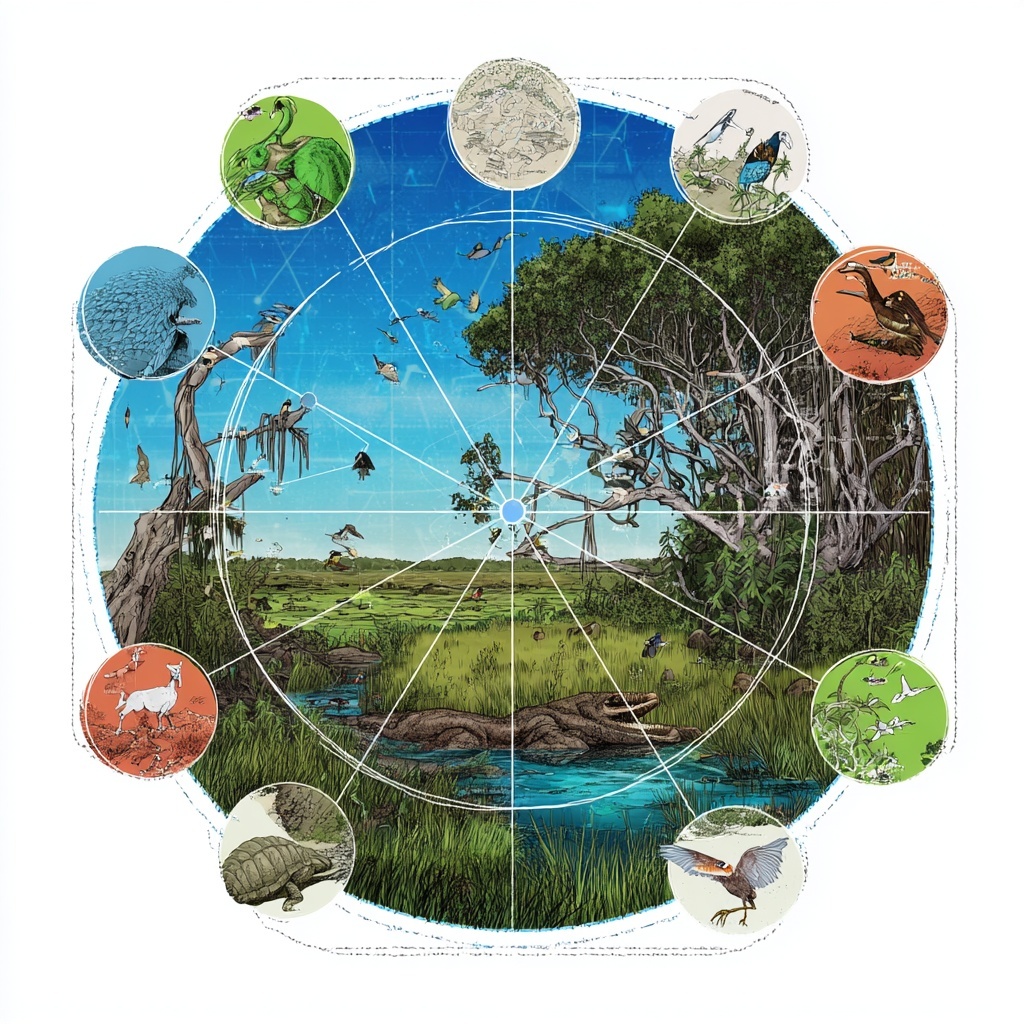
BiodivScen Project Summary: Scenarios for Biodiversity and Ecosystem Services
The BiodivScen project was an initiative to address the critical gap between insufficient knowledge and the escalating issues of biodiversity and ecosystem services (ESS) degradation. The project aimed to promote and support coordinated international research focused on developing scenarios of biodiversity and ESS to inform policy and raise public awareness, similar to how scenarios are used for climate change.
🎯 Overall Objectives and Global Coordination
BiodivScen networked 27 funding agencies from 24 countries across Europe and other continents. Its main purpose was to strengthen research program coordination and provide policy-makers with the adequate knowledge, tools, and practical solutions needed for conservation and sustainable use of biodiversity and ecosystems.
Core Objectives
- Coordinate Research: Agree on shared research priorities related to scenarios of biodiversity and ESS among major European and international research funders.
- Implement Joint Call: Design and implement an ambitious joint call for research proposals on the development of these scenarios.
- Promote Collaboration: Foster trans-national and trans-disciplinary research collaboration to build capacity and overcome fragmentation.
- Encourage Dialogue: Support dialogue and collaboration between academia, research stakeholders, and relevant socio-economic sectors to increase the impact of research on policy and practice.
- Ease Uptake: Ensure the rapid and efficient uptake of funded research results by the IPBES (Intergovernmental Science-Policy Platform on Biodiversity and Ecosystem Services) for its future assessments.
- Data Sharing: Reinforce open access to data and data sharing, and evaluate the added value of long-term collaboration between BiodivERsA and the Belmont Forum.
💡 Main Results and Achievements
The project’s success was largely driven by the implementation of its joint call and the structuring of additional activities to maximize impact.
Joint Call Success
- Funding Scale: Successfully launched and implemented a joint call for research proposals on biodiversity scenarios.
- Results: Despite a large number of applications, 21 projects were selected for funding, totaling €28 million, which exceeded the announced reserved budget by €3 million. This resulted in a satisfactory success rate of approximately 16%.
- Trans-continental Scope: The call achieved massive international collaboration, with a large majority of funded projects being trans-continental and all continents being represented.
Additional Activities (Uptake and Capacity Building)
- Internationalization: Established a Working Group (WG) to map research collaborations between different global regions, enhancing the international vision.
- Data Management: Developed a WG on open access to data, incorporating national practices and Belmont Forum data principles. This led to the production of a guidance document for funded projects and future applicants.
- Science-Policy Interfacing: Finalized an implementation plan for the uptake of research results, outlining objectives, priorities, and organizations to be targeted, including collaborations with socio-economic sectors.
- IPBES Collaboration: Explored and drafted a cooperation framework with the IPBES Technical Support Unit on Scenarios and Models.
🚀 Progress Beyond State-of-the-Art and Expected Impact
BiodivScen pushed the state-of-the-art by aligning global research on ESS, ensuring that the research produced is directly relevant and useful for high-level decision-making.
Global Capacity: The trans-continental success of the call and the mapping assignment on international research collaborations enhance the global capacity for developing and utilizing biodiversity scenarios.
Filling Knowledge Gaps: The 21 funded projects implement the recommendations made by IPBES in its methodological assessment, specifically by developing multiscale and multidriver scenarios and explicitly considering uncertainty.
Enhanced Policy Relevance: The projects demonstrate potential policy/societal relevance and integrate stakeholder engagement from the outset, ensuring the resulting scenarios are appropriate to support decision-making and are expected to feed future IPBES assessments.
Harmonized Voice: By strengthening collaboration within the European Research Area (ERA) and globally (with the Belmont Forum), the program will ultimately result in a more credible and harmonized voice in terms of research on biodiversity scenarios and their use by decision-makers.