⛰️ PHUSICOS Project Summary: Nature-Based Solutions for Mountain Risk Reduction
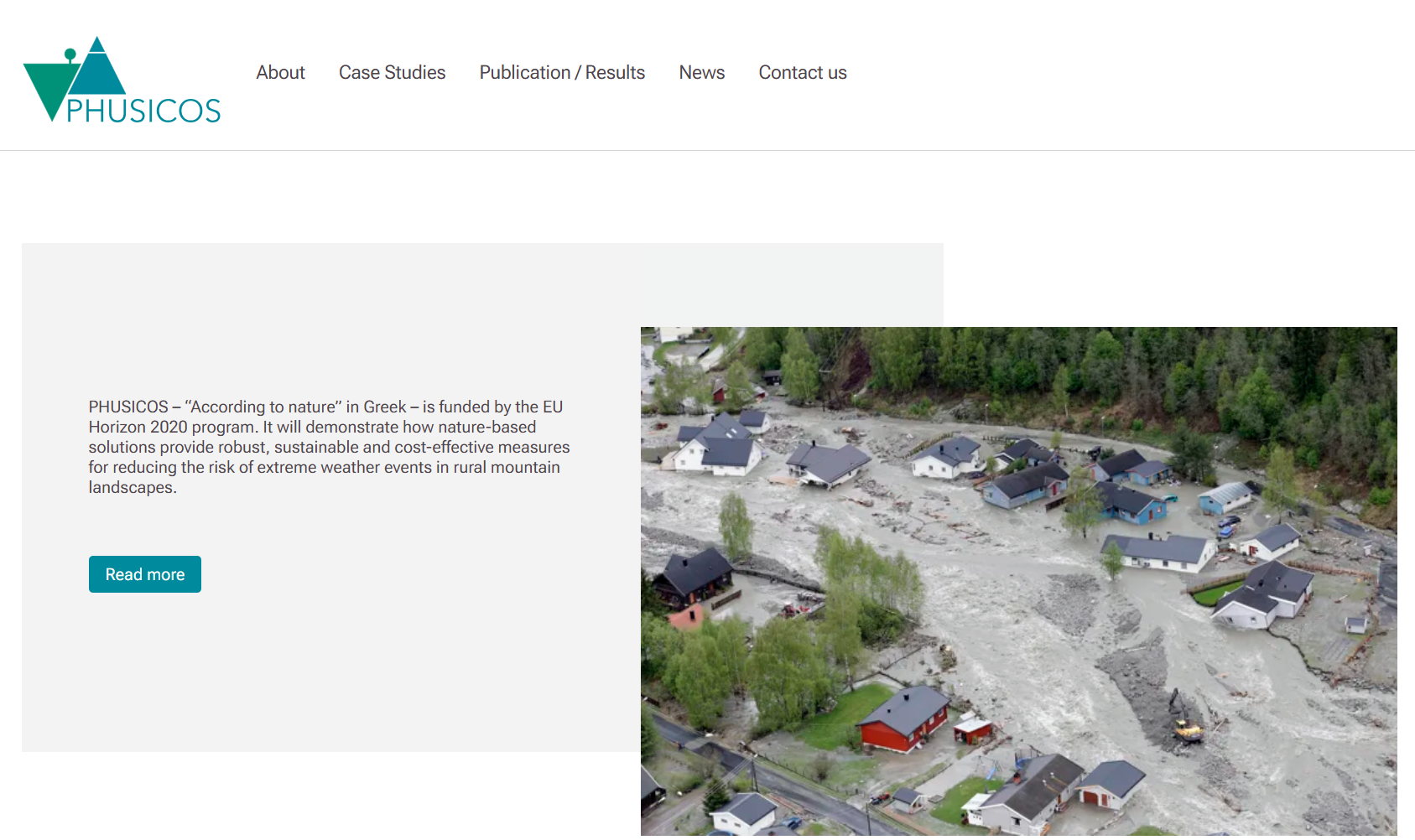
The PHUSICOS project (‘According to nature’) aimed to demonstrate the effectiveness of Nature-Based Solutions (NBS) and nature-inspired solutions for reducing the impact of extreme weather events and natural hazards in vulnerable rural mountain landscapes.
🎯 Overall Objectives and Approach
The main objective was to mainstream NBS into Disaster Risk Reduction (DRR) practices in mountainous regions, which are often overlooked in national DRR plans despite their high exposure to hydro-meteorological and geological hazards.
Core Approach
- Demonstration: Implement and monitor NBS interventions at large-scale demonstrator case sites.
- Engagement: Utilize a Living Labs approach to foster co-creation and cooperation among diverse stakeholders.
- Evidence: Develop a robust framework and collect long-term monitoring data to prove the performance and co-benefits of NBS in risk reduction.
Case Sites and Interventions
- Large-scale Demonstrators: Serchio River Basin (Italy), French and Spanish Pyrenees, and Gudbrandsdalen valley (Norway).
- Concept Cases: Kaunertal (Austria) and Isar River (Germany).
- Total Actions: 15 NBS interventions were implemented, including 11 physical measures and 4 educational/Living Lab activities, addressing hazards like flooding, debris flows, erosion, rockfall, and snow avalanches.
💡 Main Results and Key Achievements
PHUSICOS successfully bridged the knowledge gap on the effectiveness of NBS in mitigating hydro-meteorological hazards in mountain environments.
1. Implementation of Hybrid Solutions
- Physical Measures: Interventions included creating buffer strips, establishing purification/sedimentation basins, modifying canal cross-sections, afforestation, using dry masonry walls and timber gabions for terracing, and installing stone/wooden structures to secure rocks.
- The project emphasized hybrid solutions, combining vegetation with revitalized traditional building techniques.
- Learning Tools: Developed a PHUSICOS-VR simulation and virtual reality game as an innovative learning tool for stakeholders.
- Knowledge Hub: The PHUSICOS platform hosts 176 NBS entries, serving as a searchable library of resources.
2. Frameworks and Governance
- Assessment Framework: Developed the ‘Comprehensive Framework for NBS Assessment’ to evaluate and verify NBS performance, supporting decision-making and incorporating modeling of different climatic scenarios.
- Living Labs Success: Stakeholders viewed the Living Labs as a highly useful tool for engaging a broad range of actors and generating NBS knowledge.
- Inclusivity Analysis: Identified the lack of fairness in stakeholder engagement and benefit distribution as a major obstacle to successful NBS implementation, emphasizing the crucial role of co-design and co-creation.
🚀 Progress Beyond State-of-the-Art and Policy Impact
PHUSICOS generated specific recommendations intended for transfer into European policy, focusing on funding and regulation.
- Policy Recommendations:
- Climate & DRR Integration: Advocated for leveraging the EU Strategy on Adaptation to Climate Change to promote NBS for adaptation and integrate them into the EU policy sector of Disaster Risk Reduction.
- Investment & Finance: Recommended extending the scope of the EU Environmental Impact Assessment (EIA) Directive to enforce compulsory EIAs, and extending the EU Taxonomy to classify and discourage nature-negative investing.
- Sectoral Integration: Highlighted the Farm to Fork strategy as a relevant mechanism to encourage farmers in areas like the Serchio River Basin to maximize the potential of NBS.
- Legacy: The project’s post-PHUSICOS plans include long-term monitoring to continuously collect data, validate modeling outcomes, and build the evidence base needed to bolster stakeholders’ confidence and mainstream NBS.