Grant agreement ID: 821366
DOI
Project closed
EC signature date6 May 2019
Start date1 June 2019
End date31 August 2024
This summary provides a structured overview of the CIRCULAR FLOORING project (2019–2023), which developed a technical solution to the “legacy additive” problem in PVC recycling.
Project Context & Objectives
The primary obstacle to recycling flexible PVC (PVC-P) is the presence of legacy additives—specifically hazardous phthalate plasticizers like DEHP. Because these chemicals are restricted by EU regulations (REACH), traditional recycling often fails, leading to 26% of PVC waste being landfilled.
- Target Material: Post-consumer plasticized PVC flooring.
- Core Goal: Eliminate hazardous phthalates to produce high-quality, REACH-compliant recycled PVC (rPVC) and upcycle the waste plasticizers into safe alternatives.
- The “CreaSolv®” Process: A solvent-based dissolution technology designed to separate the PVC polymer from additives and impurities.
Key Results & Technical Achievements
The project successfully moved the technology from the lab to a pilot scale (TRL 6), proving that high-purity recycling is technically and economically viable.
| KPI Category | Achievement |
| Depletion Rate | >99% removal of phthalate plasticizers |
| Purity Standard | Met the <0.1 w% threshold for DEHP, DBP, BBP, and DIBP |
| Throughput | Upscaled to 15-20 kg/h at the Fraunhofer IVV pilot plant |
| Economic Potential | 32% IRR and >€100M NPV at a 30,000 t/y industrial scale |
| Climate Impact | 13 kg CO2-eq/m² for produced flooring (Cradle-to-Gate) |
Main Deliverables & Innovations
1. Dissolution-Based Recycling
Unlike mechanical recycling, which keeps additives in the mix, this process dissolves the PVC in a specific solvent. The hazardous plasticizers are separated, and the pure PVC polymer is precipitated. This allows for the production of “virgin-like” rPVC that can be used even in sensitive applications.
2. Plasticizer Upcycling (Hydrogenation)
CIRCULAR FLOORING did not just remove the waste phthalates; it transformed them. Through a combined transesterification-hydrogenation process, harmful waste phthalates were converted into DINCH—a safe, non-phthalate plasticizer widely used in modern industry.
3. Product Integration: Luxury Vinyl Tiles (LVT)
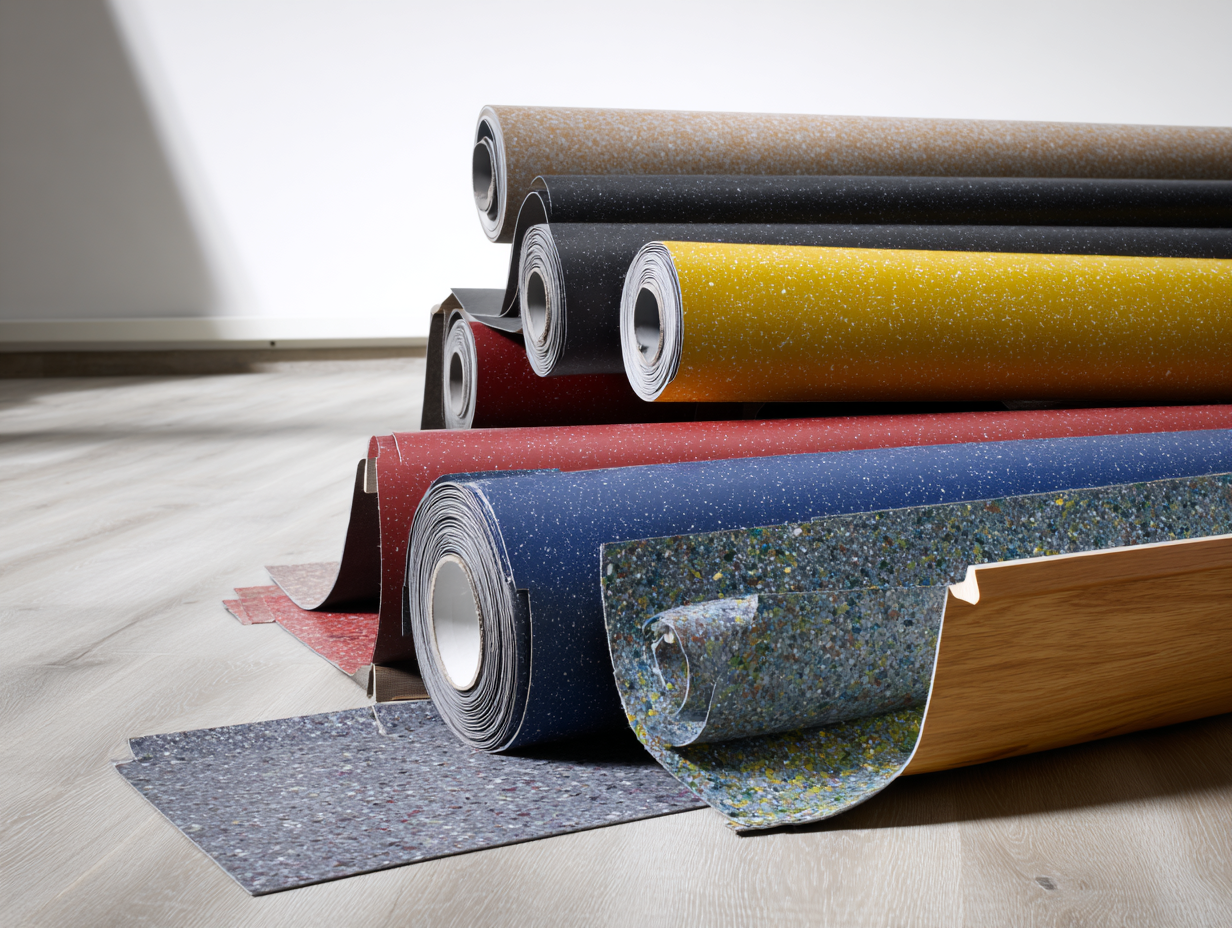
The project proved that rPVC could be re-integrated into new flooring production.
- The Bottom Layer: rPVC was found to be particularly suitable for the backing layers of heterogeneous floor coverings.
- Performance: Production tests confirmed that the recycled material could be restabilized and processed using standard industrial equipment, overcoming initial mixing challenges.
Socio-Economic & Policy Impact
CIRCULAR FLOORING provides a roadmap for the flooring industry to meet the increasingly strict requirements of the EU Green Deal.
- Regulatory Compliance: Enables the industry to meet “recycled content” quotas mandated by the revised Construction Products Regulation and Green Public Procurement.
- Resource Independence: Reduces reliance on crude oil for virgin PVC production, contributing to a 20% reduction in non-renewable material intensity (SPIRE PPP target).
- Industrial Viability: With roughly 400,000 tonnes of PVC flooring waste generated annually in Europe, the project demonstrated that there is sufficient volume to support large-scale industrial plants (30,000 t/y).
- Societal Benefit: Removes hazardous “legacy” chemicals from the circular loop, ensuring that the next generation of building materials is safer for human health and the environment.