🍎 EdiCitNet Project Summary: Integrating Edible City Solutions
The Edible Cities Network (EdiCitNet) project addressed urgent urban societal challenges—such as mass urbanization, social inequity, and environmental change—by promoting the systemic use of urban landscapes for food production. The project’s core focus was raising awareness and facilitating the implementation of Edible City Solutions (ECS), which are initiatives that empower local communities through inclusive, participatory dynamics to foster social cohesion and green economic growth.
🎯 Overall Objectives and Approach
EdiCitNet used a multi-stakeholder-oriented and transdisciplinary approach to formally implement project outcomes and encourage citizen co-creation across 11 global cities, spanning Europe, South America, the Caribbean, Africa, and Asia.
City Implementation Models
- Living Lab Cities (5): Andernach, Berlin, Oslo, Havana, and Rotterdam demonstrated their unique ECS experiences through closely monitored, co-created Living Labs.
- Masterplanning Cities (7): St. Feliu de Llobregat, Šempeter pri Gorici, Montevideo, Guangzhou, Lomé, Berlin, and Carthage focused on anchoring ECS within their urban planning frameworks using the Transition Pathway Methodology for replication.
Local & Global Structure
- City Teams (CTs): Interdisciplinary local teams served as the “local communities of practice and knowledge,” forming the backbone of the global Edible Cities network.
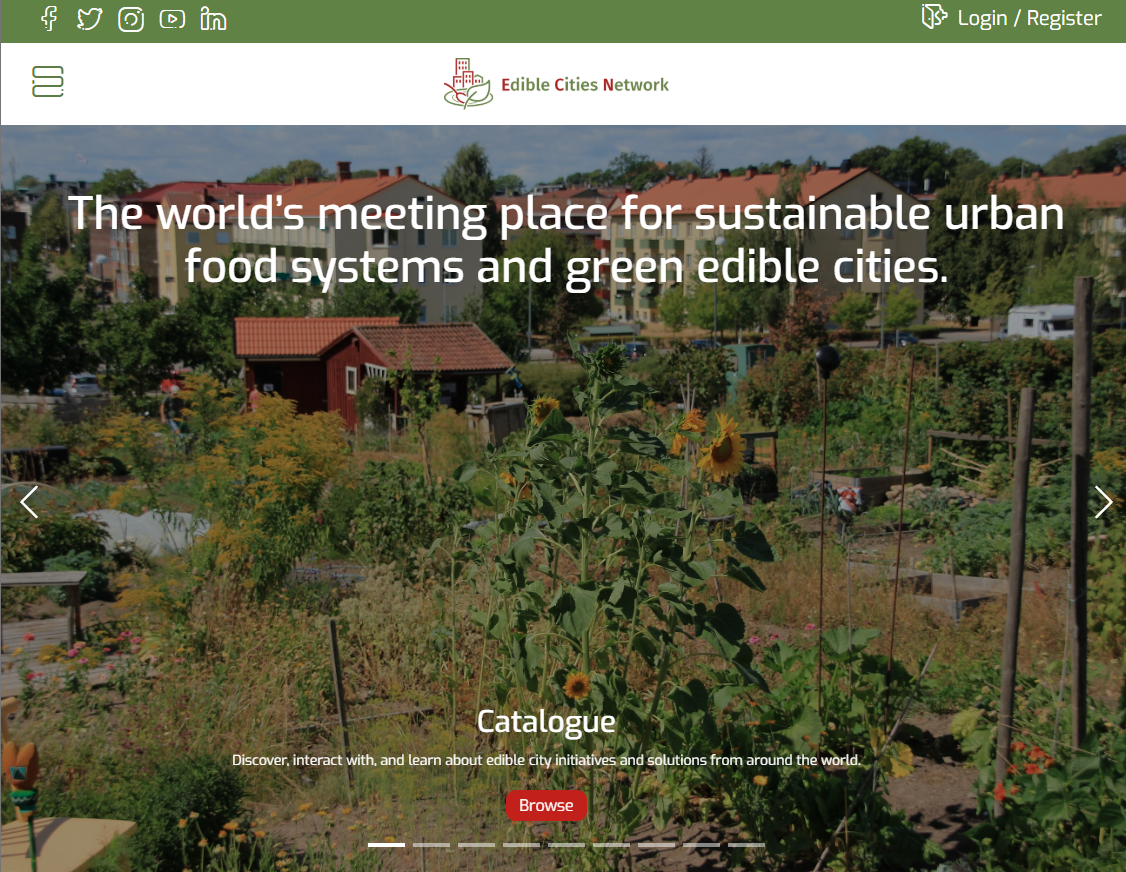
- EdiCitNet Platform: Established as the project’s open and global knowledge base, functioning as a hub for networking, collaboration, business consultancy, and urban design tools.
💡 Main Results and Key Achievements
The project’s key results focused on practical tools, knowledge consolidation, and community expansion leading up to its end in February 2024:
1. Knowledge and Digital Tools
- EdiCitNet Platform: Consolidated three former websites (Toolbox, Marketplace, Community Management Tool) into a single multifunctional platform.
- The platform and its database now host nearly 500 profiles of ECS and over 90 urban food initiatives.
- It offers resources, networking opportunities, and access to consulting services.
- “Making Cities Edible” MOOC: Established as a structured, tailor-made knowledge base of project content. It will be part of a new elective course at the University of Ljubljana.
- Serious Game: Successfully designed and tested for integration into the Transition Pathway Methodology.
- Business Support Tools: Developed the Diamond Model tool, the Growing Jobs in Agriculture Playbook, and the Consulting Guidebook to help urban food initiatives set up successful businesses.
2. Implementation and Replication
- Masterplans: The Transition Pathway Methodology was adapted to seven cities, resulting in seven co-created masterplans for anchoring ECS in urban planning frameworks.
- Business Support: Organized 23 tailored Business Model Workshops and 12 one-on-one consultancies for urban food initiatives in the participating cities.
- Lessons Learned: Conducted extensive interviews ($\approx 219$ total) and surveys with urban food initiatives to gather valuable insights on (Up)scaling ECS.
3. Network and Outreach
- The project network experienced substantial growth, attracting 2,402 members/newsletter recipients in 33 countries.
- Produced over 250 pieces of translated educational and dissemination content.
- Strengthened collaboration with sister projects through joint campaigns and participation in NBS taskforces.
🚀 Progress Beyond State-of-the-Art and Impact
EdiCitNet made significant strides in advancing the urban food movement by formalizing and networking previously isolated initiatives.
- Network-Based Governance: The project successfully initiated a transition towards a network-based governance model, strengthening CTs and actively dismantling silo-thinking as a barrier to ECS implementation.
- Inclusiveness and Social Impact: Demonstrated that inclusive urban regeneration and social impact can be achieved through co-creation and the formation of innovative, transdisciplinary local partnerships.
- Diverse Living Labs: Established five diverse Living Labs that go beyond simple urban landscaping, addressing complex social challenges like densification in disadvantaged neighborhoods, fostering bottom-up stakeholder involvement, and increasing food sovereignty and security.
- Sustainable Legacy: The establishment of the long-term platform and the MOOC ensures that the knowledge base and networking opportunities will prevail beyond the project’s lifetime.