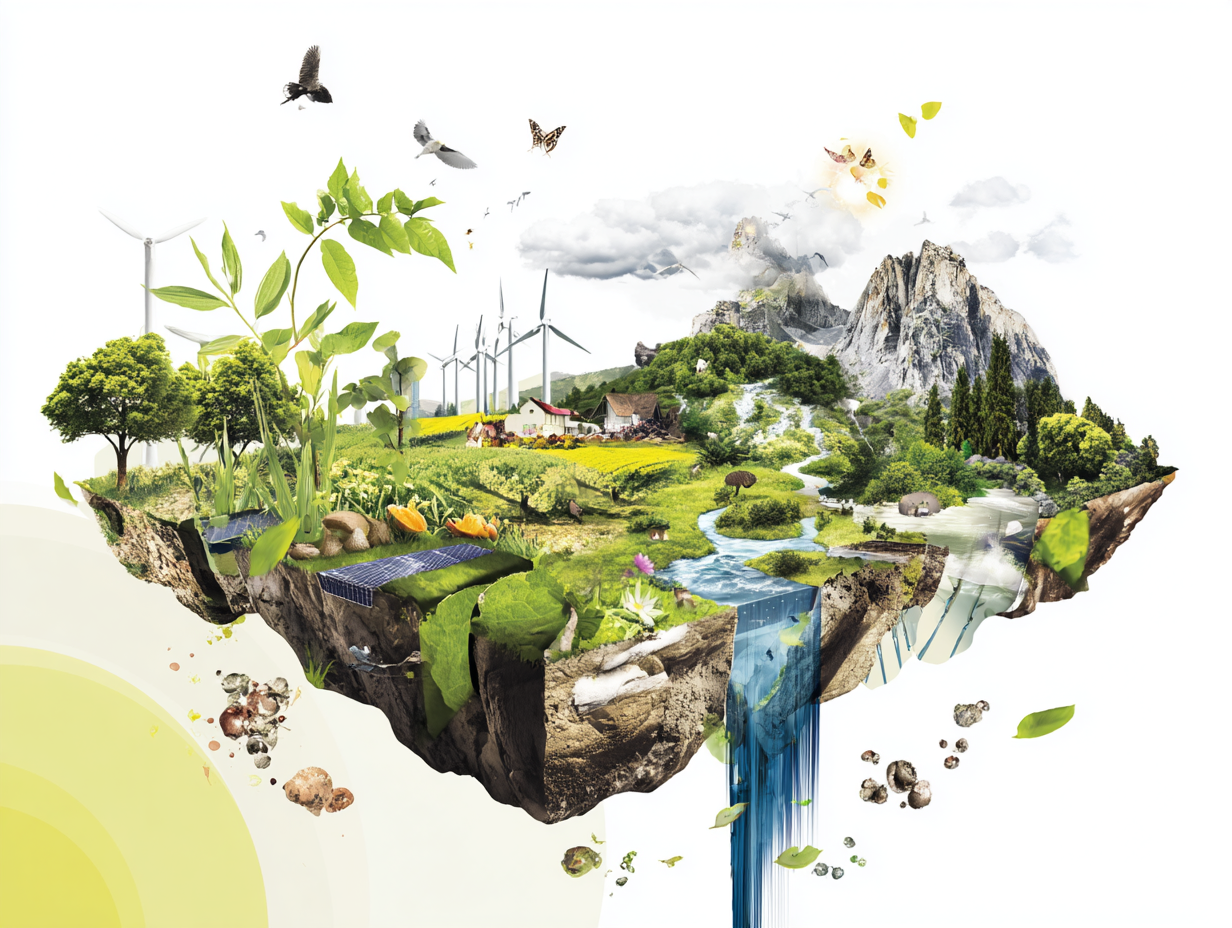
Despite improved understanding of the links between ecosystem health, provision of ecosystem services and human well-being, further conceptual and empirical work is needed to make the ideas of ecosystem services (ESS) and natural capital (NC) operational. OpenNESS will therefore develop innovative and practical ways of applying them in land, water and urban management: it will identify how, where and when the concepts can most effectively be applied to solve problems.
The OpenNESS project focused on translating the concepts of ecosystem services and natural capital into operational frameworks for sustainable land, water, and urban management. Key outcomes included advancing conceptual understanding, testing methods in real-life case studies, and creating guidance tools and the knowledge platform Oppla.
💡 Key Results and Contributions
The project achieved its overall objective through several significant outputs:
Conceptual and Operational Advancement
- Glossary and Reference Book: Created a Glossary with over 200 agreed terms and an Ecosystem Service Reference Book (27 Synthesis Papers) to provide a consistent conceptual foundation.
- Classification Guidance: Applied the Cascade Model and CICES categories in case studies and developed a translator tool (using HUGIN Bayesian Belief Network Software) to improve classification and cross-reference work with other frameworks (MA, TEEB, UKNEA). The Cascade Model (Figure 5 in the report) links society and nature through ecosystem services:
- OpenNESS Conceptual Nexus (ONEX): Developed ONEX, a “working environment” based on social media tools (TRELLO), to support deliberative processes and structure decision-making in the application of ecosystem service thinking. It uses the four societal challenges (human well-being, sustainable ecosystem management, governance, and competitiveness) as entry-points.
Real-World Application and Method Testing
- 27 Case Studies: Applied the concepts and methods in 27 real-life case studies across Europe and beyond, covering diverse social-ecological systems like urban planning, water management, and multi-functional landscapes (Figure 2 in the report).
- Stakeholder Engagement: Emphasized that ecosystem service knowledge is most effective when decision-makers and stakeholders are closely involved (participatory action research approach).
- Methodological Guidance: Tested 43 methods (biophysical, socio-cultural, monetary) and produced an integrative assessment framework, a set of decision trees for method selection, and 31 method factsheets, all available via Oppla.
Policy Analysis and Scenarios
- Policy Mainstreaming: Policy analysis showed that the ecosystem services concept is not yet mainstreamed across all EU policy sectors, being confined mainly to biodiversity, forestry, and agricultural policies. Policy briefs were created for key sectors.
- Scenario Development: Developed four EU level scenario storylines to assess future impacts of drivers on land-use, biodiversity, and ecosystem services. These scenarios were subsequently used in the IPBES report 2(d) for Europe and Central Asia.
Knowledge Dissemination and Legacy
- Oppla Platform: Project results were synthesized into Oppla, a joint knowledge platform with the OPERAs project, to collate information on ecosystem services, natural capital, and nature-based solutions.
- Dissemination: Contributed to conferences and summer schools, with 99 scientific articles and over 200 local outreach events.
🎯 Project Objectives Summary
The project was structured around seven specific objectives, integrating methodological advances and empirical analysis in an iterative cycle:
- Advance Conceptual Understanding: Create operational frameworks for ecosystem services and natural capital.
- Examine EU Regulatory Frameworks: Analyze how policies can enhance or restore ecosystem service benefits.
- Develop Biophysical Methods: Refine approaches for mapping and modeling the biophysical control of ecosystem services.
- Develop Hybrid Methodologies: Create methods combining monetary, non-monetary, and deliberative approaches to address trade-offs and conflicts.
- Apply Concepts in Case Studies: Test methods in 27 place-based case studies with stakeholders.
- Translate Results: Integrate outputs into a Menu of Multi-Scale Solutions and policy recommendations (now part of Oppla guidance tools).
- Disseminate Results: Promote science-policy dialogue and broad audience uptake.
The work program (Figure 1 in the report) progressed through WPs for conceptual foundation (WP1), method development (WPs 2-4), application in case studies (WP5), integration and database creation (WP6), and dissemination (WP7).